
 2025-12-11
 https://metro.co.uk/2025/12/11/unexploded-bombs-drone-strikes-poisoned-crops-frontline-olive-farming-25343816/
HaiPress
https://metro.co.uk/2025/12/11/unexploded-bombs-drone-strikes-poisoned-crops-frontline-olive-farming-25343816/
HaiPress
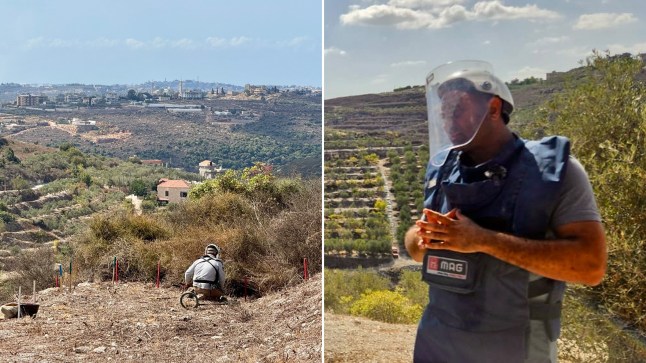
Ahmad Mustafa,a field operations manager with the Mines Advisory Group (MAG),a UK-based charity clearing land across Lebanon (Picture: Gergana Krasteva)
Hiba Ghandour and her husband had been having the same argument for days.
At stake was the modest olive grove she inherited in Lebanon’s village of Arnoun,in Nabatieh governorate,which is at the centre of renewed Israeli attacks that are flouting the one-year-old ceasefire.
Their 10 trees will barely produce more than a few bottles of oil,but for the family,they hold roots deeper than their harvest.
With the fruit hanging heavy on the branches – and only a few days left until it would spoil – Hiba’s husband was determined to travel to the village.
She refused,arguing that the area is unsafe amid Israel’s wave of airstrikes on the south and north of the country.
‘I keep telling my husband,“Who knows what could happen when you go to Arnoun. It is not worth the risk,”‘ she tells Metro,days before he eventually made the trip – in secret – successfully picking the fruit.
‘We can survive without the olives… it is more about the sentimental value. For my husband,they are a symbol of something. He planted them with his own hands. He took care of them,nourished them.’
As programme manager with the Mines Advisory Group (MAG) in Lebanon,Hiba understands better than most the dangers of harvesting olives in land still littered with unexploded ordnance (UXOs) from the 2023-2024 war.
Since the ceasefire on November 27,2024,the UK-based charity has so far cleared an estimated 548,111 square metres of olive groves from shrapnel,cluster munitions and other deadly weapons,declaring them safe.
From a hilltop in the southern village of Kfarmelki,15 miles from the border with Israel,Metro watches as deminers in blast-resistant armour,carrying metal detectors,move from one patch to another.
@gergana.krasteva On the ground in Lebanon with MAG deminers who are working to clear some of the most contaminated land as people return to their homes. My latest dispatch for @Metro P.S. I travelled to Lebanon in October – the situation has changed massivelysince then,with further escalations. #news #lebanon #beirut #geopolitics #journalism
♬ original sound – Gergana Krasteva | Journalist
So far,they have uncovered and destroyed 180 cluster munitions,many of which were scattered in the olive groves stretching ahead,as far as the eye can see.
Until the ceasefire,around 90% of people in the village had fled because of the bombardments – but many made the perilous journey back to check on their homes and farmland,despite warnings of UXOs.
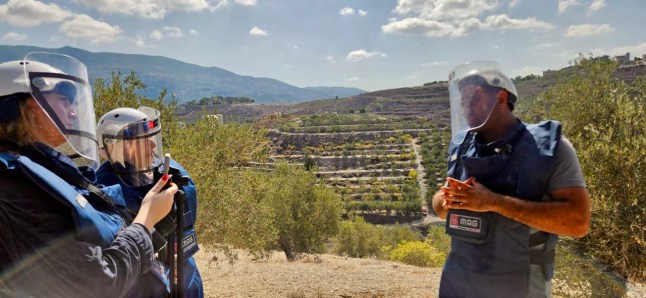
Hiba (middle) understands better than most the dangers of harvesting olives in land still littered with unexploded ordnance (Picture: MAG)
Hiba says: ‘People need any source of income,and this [olive trees] is their livelihood,so it is difficult to teach them safe behaviour.
‘This is one of the challenges that our community faces. The second is in the clearance itself because you do not want to damage anything.
‘God forbid you damage a tree. God knows what will happen. Even if MAG takes all the measures,sometimes accidents would happen. So it is very,very risky.’
Mohamad Sewan,the self-declared ‘best baker’ in Kfarmelki,had fled to a village near the town of Saida,but travelled every two to three days to see if his bakery was still intact.
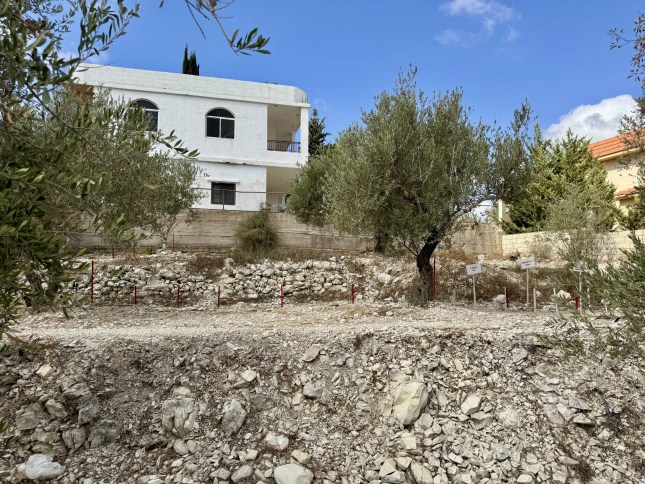
Olive groves at a mined site in the southern village of Kfarmelki,15 miles from the border with Israel (Picture: Gergana Krasteva)
‘Alhamdullilah,nothing was damaged,’ he confirms,while loading the oven with Lebanese flatbread to bake.
But his olive grove was contaminated and multiple UXOs were discovered by MAG deminers.
Still with a smile on his face,Mohamad says: ‘The whole crop was wasted. I used to produce 37 tanks of olive oil. This year,I did not even collect one tank.
‘I also used to cultivate 32 boxes of sumac but this year,it was poisoned.’
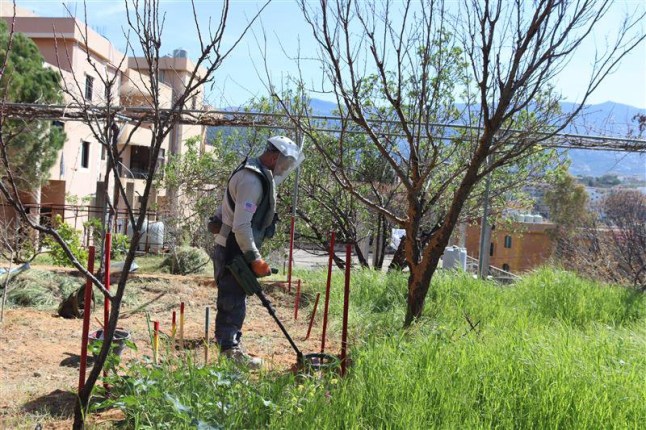
MAG deminers have been clearing the village for seven months (Picture: MAG)
Ahmad Darwish,the former head of Kfarmelki,knows all too well about the loss people have endured.
He greets us at the gate of his olive mill as his eyes linger on the now idle presses.
For the first time in 19 years,since the 34-day war between Hezbollah and Israel in 2006,he made the impossible decision to not pick the fruit due to how contaminated the land is.
After spending a lifetime coaxing oil from his land,Ahmad’s livelihood has again been paralyzed. So is the case for the workers he employs.

Ahmad Darwish,made the difficult decision not to pick the olive trees this year (Picture: Gergana Krasteva)
He says: ‘Returning to Kfarmelki was not easy and to this day,many people fear accessing their lands [because of UXOs].
‘Currently,it is the olive season,and a lot of families’ livelihoods depend on the olive harvest entirely.
‘Almost every year,farmers in the village would produce between 10,000 and 15,000 tanks of olive oil.’
For many of them,what will come next remains uncertain.

Across the south,more than 60,000 trees burnt in Israeli airstrikes between 2023 and 2024 (Picture: Gergana Krasteva)
Israel’s decades-long pattern of attacks on olive trees not just in Lebanon,but also the West Bank,is like a dagger through the hearts of the farming families.
Across the south,000 trees burnt in Israeli airstrikes between 2023 and 2024,Lebanese agriculture minister Abbas Hajj Hassan warned in a report from March last year,but since then the number has risen even more.
Among the hardest hit areas have been the Nabatieh,South Lebanon,and Bekaa governorates – that are rich in ancient and new groves – and together account for around half of the country’s olive oil production.
Hiba says: ‘There is often a stronger reaction to olive trees being destroyed than people’s own homes.
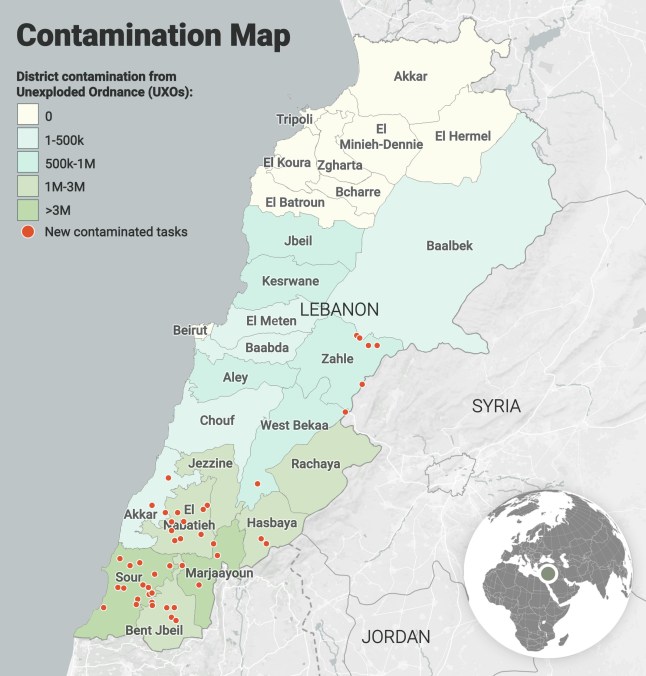
A map showing the level of contamination across Lebanon (Picture: Metro)
‘We see the frustration and the loss of hope – though I do not even know if I should say that word anymore,“hope” – because of what people have lost.’
Both Mohamad and Ahmad tell Metro that this year’s harvest was already ‘doomed’ because of the impact of strikes on the environment.
Human Rights Watch and Amnesty International have documented Israel’s widespread deployment of white phosphorus munition in populated areas,which is banned by UN convention.
Besides severely wounding people by sticking to their skin and clothing,it has long-term effects on the water and air,including poisoning the soil.
Yesterday afternoon,UNIFIL peacekeepers observed a series of Israeli airstrikes in our area of operations in south Lebanon,in the villages of Marounah,Majadel,and Baraashit.
— UNIFIL (@UNIFIL_) December 5,2025
For people in the south,purchasing olives is sacrilegious. After all,they are the backbone of their economy,and inherent to their culture.
So they persist,unwrapping vast nets under heavy olive branches to catch the ripe fruit.
This is also the case along the Blue Line,the temporary boundary drawn by the UN after Israel pulled out of south Lebanon in 2000,which has become practically inaccessible due to continuous clashes.
Throughout October,the Lebanese Armed Forces (LAF) and United Nations peacekeepers carried out 40 deployments to protect farmers during their olive harvests.
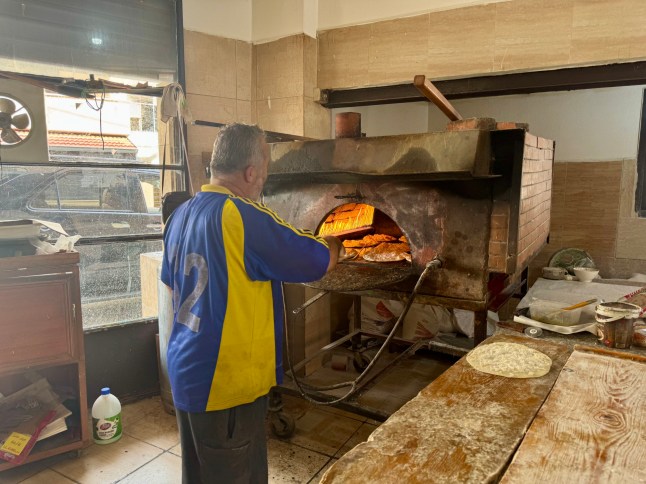
Mohamad Sewan,the self-declared ‘best baker’ in Kfarmelki (Picture: Gergana Krasteva)
Major general Paul Sanzey,from UNIFIL,said: ‘This year’s harvest holds particular significance,as olive picking in several areas in South Lebanon had not been possible since 2022 due to hostilities.’
Prior to the conflict,agriculture was vital for Lebanon’s food security,and played a crucial role in sustaining rural livelihoods,particularly for women.
The World Bank estimates that the damage to the sector is worth around £60 million,with severe impact on infrastructure,livestock,fisheries,crop production and irrigation systems.
The Nabatieh governorate suffered the most damage – around £32 million – followed by the South governorate and Bekaa governorate.
Until the land is safe – both from UXOs and environmental damage – people will have to somehow make the impossible choice whether to abandon their crops to rot.